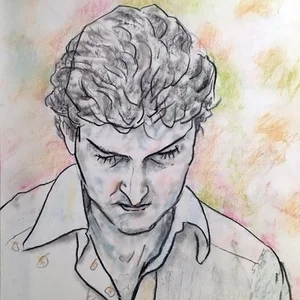
EVEN ITALIAN
There were no Italians in my childhood, none. My TV viewing in those years was limited to I Love Lucy, the Milton Berle show, Tom Corbett Sace Cadet and The Lone Ranger. Again, no Italians.
Years later, namely three years ago, I met a new friend, a fifty-ish Italian from Tuscany, though I had already put a few trips to Italy under my belt, mostly, Rome, Florence and Venice and had acquired some casual friendships with a few Italians from those regions. But it was my new friend who introduced me to a fuller concept of what it means to depict Italian.
He spoke with facial and and upper body (especially arms and hands) flourishes that seemed to define, delimit, and describe Italian in ways particularizing that culture and its nonverbal modes of expression.
His first conversation, mostly an extemporaneous monologue, was so fitted with facial, arm and hand gestures that the accompanying words were being drowned out as his extrapolations wended on.
What was he talking about? I can only partly recollect but would state that he was explaining what being Italian and coming to live in New York and meeting Americans entailed. Namely, how to comprehend differences usually hidden in the flow of small talk, in which meaning and nuance and vocal tone veiled and ultimately decomposed meaning and understanding. It was speaking the same language, where accent and vocabulary created missed readings, however much present, did not signify total misunderstanding. But the nonverbals, the Italian extra-linguistic gesticulations of face, arms and hands, raised the Italian’s conversation to a maximum level of astonishment and dumb mesmeric misreading.
It made me want to hear and see more, like becoming a fan of the performer, before becoming a friend. Yet the friendship grew out of becoming enveloped in that Italian language, spoken and danced by face and upper body.
Then comes the emotional values, the content of the conversation addressed in its totality. What my friend was conveying was his sense of himself confronting a new world and an alien form of language. Not just words to translate and ideas to assimilate and figures of speech to corroborate. But the taste and flavor of himself, and his Italian essence. He was trying to convey his Italian authenticity, because that defined him. He could only been known in that florid, localizing, delineating, comprehensive means. Being Italian was his corporal suit of clothes.
Then followed the stuff of friendship, that multiplicity of shared interests, varying opinions, impulses to explain and defend and convince, and seeds of further exploration. He Italian, me American. A world of difference and similarities, all to be sorted and enjoyed in the process.
I am learning Italian. Duolingo isn’t helping much.